Monday, 8 December 2014

Eschatology : Event No 18 of the Tribulation. Destruction of Economic and Political Babylon.

Revelation 17 and 18
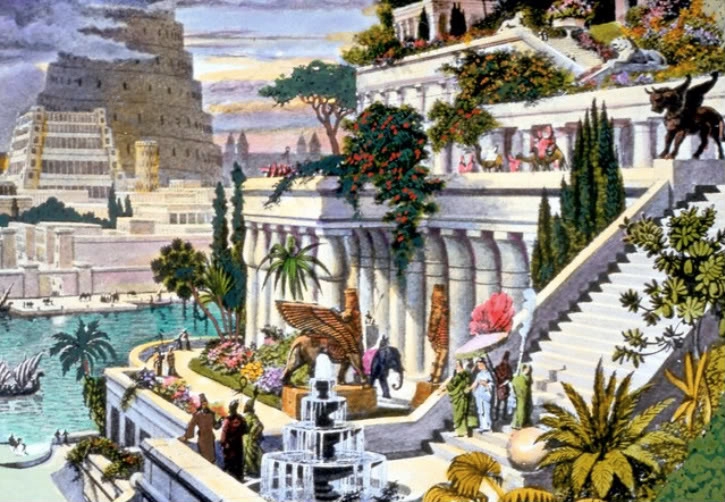
The hanging Gardens of Babylon Wikipedia.com

Rev 14:8  And another, a second angel, followed, exclaiming, "Great Babylon has fallen, has fallen--she who made all the nations drink the wine of the anger provoked by her fornication."
Babylon
Here is the first mention of Babylon found in this book. Some suggest that “Babylon” should not be understood in a literal sense, but as denoting a spiritual location describing the centers of commercial success and sin attending each age of history (Rev. Rev. 17:5+). Some see “Babylon”as a code word for the city of Rome. Some believe “Babylon” means Jerusalem. Others are unsure what it means, or that its identification is important. It is our view that “Babylon” describes the literal city of history on the banks of the Euphrates River, originating with the kingdom of Babel established by Nimrod (Gen. Gen. 10:8-10). The city has had great influence throughout history, both in political and religious realms, and is to be rebuilt in the time of the end and to ultimately suffer God’s wrath. Biblestudytools.com

Rev 16:18  And voices and thunders and lightnings occurred. And there was a great earthquake, such as has not been since men were on the earth, so mighty and so great an earthquake.
Rev 16:19  And the great city came to be into three parts, and the cities of the nations fell. And great Babylon was remembered before God, to give to her the cup of the wine of the anger of His wrath.

Babylon - This is the first time that the word “Babylon” occurs in this book, though it is repeatedly mentioned afterward, Rev_16:19; Rev_17:5; Rev_18:2, Rev_18:10, Rev_18:21. In reference to the literal Babylon, the word is used, in the New Testament, in Mat_1:11-13; Act_7:43; 1Pe_5:13. See Intro. to 1 Peter, section 2. Babylon was a well-known city on the Euphrates (for a full description of which see the notes on Isaiah, analysis of chapters 13 and 14), and was, in the days of its pride and glory, the head of the pagan world. In reference to the meaning of the word in this place, it may be remarked:
(1) That the general characteristics of Babylon were, that it was proud, haughty, insolent, oppressive. It was chiefly known and remembered by the Hebrew people as a power that had invaded the Holy Land; that had reduced its capital and temple to ruins; that had destroyed the independence of their country, subjecting it to the condition of a province, and that had carried away the inhabitants into a long and painful captivity. It became, therefore, the emblem of all that was haughty and oppressive, and especially of all that persecuted the church of God.
(2) the word must be used here to denote some power that resembled the ancient and literal Babylon in these characteristics. The literal Babylon was no more; but the name might be properly used to denote a similar power. We are to seek, therefore, in the application of this, for some power that had the same general characteristics which the literal Babylon had.
(3) in inquiring, then, what is referred to here by the word “Babylon,” we may remark:
(a) that it could not be the literal Babylon on the Euphrates, for the whole representation here is of something future, and the literal Babylon had long since disappeared, never, according to the prophecies, to be rebuilt. See the notes on Isa_13:20-22.
(b) All the circumstances require us to understand this of Rome, at some period of its history: for Rome, like Babylon, was the seat of empire, and the head of the pagan world; Rome was characterized by many of the same attributes as Babylon, being arrogant, proud, oppressive; Rome, like Babylon, was distinguished for its conquests, and for the fact that it made all other nations subject to its control; Rome had been, like Babylon, a desolating power, having destroyed the capital of the Holy Land, and burnt its beautiful temple, and reduced the country to a province. Rome, like Babylon of old, was the most formidable power with which the church had to contend. Barnes Notes

Rev 18:1  And after these things I saw another angel come down from Heaven, having great authority. And the earth was lighted up from his glory.
Rev 18:2  And he cried mightily with a strong voice, saying, Babylon the great has fallen, has fallen! And it has become the dwelling-place of demons, and a prison of every unclean spirit, and a cage of every unclean bird which has been hated, WNT


Ishatar gate, Bab ylon
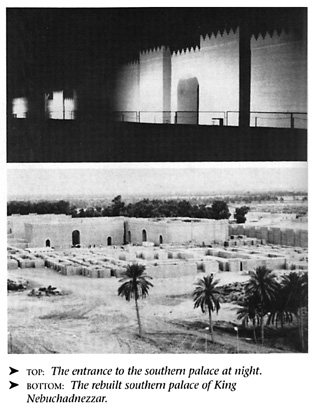
Babylon in Iraq is one of the most famous archaeological sites in the world. A Mesopotamian capital that flourished for centuries, it was home to Hammurabi (1792-1750 B.C.) who introduced the world’s first known set of laws, and Nebuchadnezzar (604-562 B.C.) who built the famed Hanging Gardens of Babylon.
Time has taken its toll, and so has the modern world. Saddam Hussein decided to rebuild Babylon with modern bricks inscribed with his name, right atop the original walls.
Then came the war to topple him. An American military base was established at Babylon that was soon taken over by Polish troops. A British Museum report on damage to Babylon states that large areas of the site were leveled in order to make a parking lot, roads and areas for tents and bunkers.
Trenches were also dug to give protection to the soldiers. Many of the countless sandbags around the base were filled with soil from the archaeological site. The Ishtar Gate, shown here in this Wikimedia Commons image, suffered significant damage.
Now saline water is leaching into the area, eroding the ancient brick, and three oil pipelines pass right through Babylon.
Despite this, Iraqi archaeologists are applying to get Babylon on UNESCO’s World Heritage List. Because of the extensive damage to the site and Saddam’s “reconstruction,” UNESCO has turned down previous applications – twice.
Now Iraq is trying a new tactic. The proposal now includes the historical significance of the Saddam and Coalition eras. Babylon saw many periods of occupation, after all, and these are the two latest. It’s an interesting tactic and if it works, Babylon would attract more serious efforts from the Iraqi and other governments to preserve one of humanity’s great ancient cities.<http://gadling.com/tag/babylon/>


I do not think the Great Babylon mentioned in the Book of Revelation is literally in Iraq -- I've been taught it is Rome. Your thoughts?
A. Scripture teaches that Babylon is actually two entities intertwined in Chapters 17 and 18. The first Babylon is a literal, physical place during the time of Tribulation from where the Antichrist rules. The second Babylon is the Harlot, a religious system the Antichrist uses to control the world in the last days.
Scripture distinguishes between two Babylons in the end times, the place and the religious system, which are two sides of the same coin. The Bible calls the religious system led by the False Prophet "Babylon," while the world headquarters of the religion's False Prophet is located in the geographical Babylon, which is also the Antichrist’s capital city.www.versebyverseministry.org/images/uploads/babylon

Wednesday, 3 December 2014

Eschatology - 17b The Seven Bowls of final God's Wrath Explained

The First Bowl - Bad and Painful Sores

Rev 16:1  Then I heard a loud voice from the sanctuary say to the seven angels, "Go and pour on to the earth the seven bowls of the anger of God."
Rev 16:2  So the first angel went away and poured his bowl on to the earth; and it brought a bad and painful sore upon the men who had on them the mark of the Wild Beast and worshipped his statue.

A noisome and grievous sore (helkos kakon kai ponēron). “Bad and malignant sore.” Helkos is old word for a suppurated wound (Latin ulcus), here, Rev_16:11; Luk_16:21. See the sixth Egyptian plague (Exo_9:10; Deu_28:27, Deu_28:35) and Job_2:7. The magicians were attacked in Egypt and the worshippers of Caesar here (Rev_13:17; Rev_14:9, Rev_14:11; Rev_19:20).RWP

And there fell a noisome and grievous sore - The judgment here is specifically different from that inflicted under the first trumpet, Rev_8:7. There it is said to have been that “the third part of trees was burnt up, and all green grass was burnt up.” Here it is that there fell upon people a “noisome and grievous sore.” The two, therefore, are designed to refer to different events, and to different forms of punishment. The word rendered “sore” properly denotes a wound (Homer, Iliad xi. 812), and then, in later writers, an ulcer or sore. It is used in the New Testament only in the following places: Luk_16:21, “The dogs came and licked his sores”; and in Rev_16:2, Rev_16:11, where it is rendered “sore,” and “sores.” It is used in the Septuagint, in reference to the boils that were brought upon the Egyptians, in Exo_9:9-12, and probably Deu_28:27; in reference to the leprosy, Lev_13:18-20, Lev_13:23; in reference to the boil, ulcer, or elephantiasis brought upon Job Job_2:7; and in reference to any sore or ulcer, in Deu_28:35.
In all these places it is the translation of the word שׁחין  shechiyn - rendered in our English version as “boil,” Exo_9:9-11; Lev_13:18-20, Lev_13:23; 2Ki_20:7; Job_2:7; Isa_38:21; and “botch,” Deu_28:27, Deu_28:35. The proper meaning, therefore, is that of a sore, ulcer, or boil of a severe and painful character; and the most obvious reference in the passage, to one who was accustomed to the language of Scripture, would be to some fearful plague like what was sent upon the Egyptians. In the case of Hezekiah 2Ki_20:7; Isa_38:21, it was probably used to denote a “plague-boil,” or the black leprosy. See the notes on Isa_38:21. The word “noisome” -  κακὸν  kakon, “evil, bad” - is used here to characterize the plague referred to as being especially painful and dangerous. The word “grievous” - πονηρον  ponēron - “bad, malignant, hurtful” - is further used to increase the intensity of the expression, and to characterize the plague as particularly severe. Barnes

  1. The Second Bowl - The Sea turns to Blood and the Sea Creatures die.

Rev 16:3  The second angel poured his bowl into the sea, and it became blood, like a dead man's blood, and every living creature in the sea died.
RWP Blood as of a dead man (haima hōs nekrou). At the trumpet (Rev_8:11) the water becomes wormwood. Here hōs nekrou is added to Exo_7:14-24, “the picture of a murdered man weltering in his blood” (Swete). “Coagulated blood, fatal to animal life” (Moffatt).
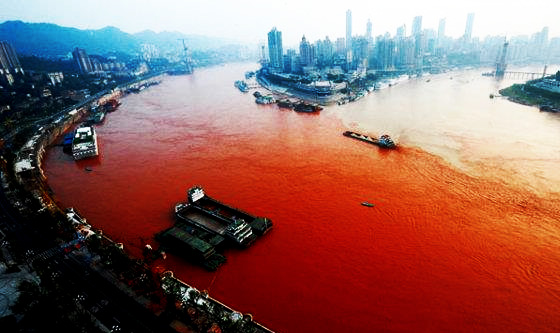
Yangtze River turned to Blood
  1. The Third Bowl - The Rivers turn to Blood.

Rev 16:4  The third angel poured his bowl into the rivers and springs of water, and they became blood.
Into the rivers and the fountains of waters (eis tous potamous kai tas pēgas tōn hudatōn). See Rev_8:10 for this phrase. Contamination of the fresh-water supply by blood follows that of the sea. Complete again.
Rev 16:5  And I heard the angel of the waters say, "Righteous art Thou, who art and wast, the holy One, because Thou hast thus taken vengeance.
Rev 16:6  For they poured out the blood of Thy people and of the Prophets, and in return Thou hast given them blood to drink. And this they deserved."
Rev 16:7  And I heard a voice from the altar say, "Even so, O Lord God, the Ruler of all, true and righteous are Thy judgments."
This seems to be the consequence of their assassinating the prophets and the saints of God in this age and in the tribulation period.
  1. The Fourth Bowl - Mankind blasphemes God as they are scorched by the sun.

Rev 16:8  Then the fourth angel poured his bowl on to the sun, and power was given to it to scorch men with fire.
Rev 16:9  And the men were severely burned; and yet they spoke evil of (blasphemed) God who had power over the plagues, and they did not repent so as to give Him glory.

Poured upon the sun (epi ton hēlion). Not eis (into) as in Rev_16:2, Rev_16:3, Rev_16:4. The fourth trumpet (Rev_8:12) affected a third of the sun, moon, and stars with a plague of darkness, but here it is a plague of extreme heat.
To scorch with fire (kaumatisai en puri). First aorist active infinitive of kaumatizō, late (Plutarch, Epictetus) causative verb (from kauma, heat), in N.T. only here and Rev_16:9; Mat_13:6; Mar_4:6. The addition of en puri (in fire, with fire) intensifies the picture.RWP


Rev 16:9  And the men were severely burned; and yet they spoke evil of (blasphemed) God who had power over the plagues, and they did not repent so as to give Him glory.

Were scorched (ekaumatisthēsan). First aorist passive indicative of same verb.
With great heat (kauma mega). Cognate accusative retained with the passive verb. Old word (from kaiō to burn), in N.T. only Rev_7:16 and here. For blaspheming the name of God see Rev_13:6; Jam_2:7; Rom_2:24; 1Ti_6:1. They blamed God for the plagues.
They repented not (ou metenoēsan). This solemn negative aorist of metanoeō is a refrain like a funeral dirge (Rev_9:20.; Rev_16:11). In Rev_11:13 some did repent because of the earthquake. Even deserved punishment may harden the heart.
To give him glory (dounai autōi doxan). Second aorist active infinitive of didōmi, almost result. For the phrase see Rev_11:13; Rev_14:7; Rev_19:7.RWP


  1. The Fifth Bowl - The Beasts Seat of Government is afflicted.

Rev 16:10  The fifth angel poured his bowl on to the throne of the Wild Beast; and his kingdom became darkened. People gnawed their tongues because of the pain,
Rev 16:11  and they spoke evil of the God in Heaven because of their pains and their sores, and did not repent of their misconduct.

The Kingdom of the Beast was struck
Upon the throne of the beast (epi ton thronon tou thēriou). TRev_13:2). The dragon gave the beast his throne (Rev_2:13).
Was darkened (egeneto eskotōmenē). Periphrastic past perfect passive with ginomai and skotoō (Rev_9:2). Like the darkness of the Egyptian plague (Exo_10:22) and worse, for the effects of the previous plagues continue.
They gnawed their tongues (emasōnto tas glōssas autōn). Imperfect middle of masaomai, old verb (to chew), from maō (to knead), only here in N.T.
For pain (ek tou ponou). “Out of distress” (cf. ek in Rev_8:13), rare sense of old word (from penomai to work for one’s living), in N.T. only here, Rev_21:4; Col_4:13. See Mat_8:12.
  1. 11 They blasphemed (eblasphēmēsan) and they repented not (kai ou metenoēsan). Precisely as in Rev_16:9, which see. Not just because of the supernatural darkness, but also “because of their pains” (ek tōn ponōn autōn, plural here and same use of ek) and their sores (kai ek tōn helkōn autōn, as in Rev_16:2, only plural, and same use of ek).

  1. The Sixth Bowl - The Euphrates dries up and the Armies of the nations gather to the battle of Armageddon.

Rev 16:12  The sixth angel poured his bowl into that great river, the Euphrates; and its stream was dried up in order to clear the way for the kings who are to come from the east.
Upon the great river, the river Euphrates (epi ton potamon ton megan ton Euphratēn). The sixth trumpet brings up the river Euphrates also (Rev_9:14), only there epi with the locative, while here epi with the accusative. Note triple use of the article ton here.
The Euphrates drying up
Was dried up (exēranthē). First aorist (prophetic) passive of xērainō (Rev_14:15). Cf. Zec_10:11.
That may be made ready (hina hetoimasthēi). Purpose clause with hina and the first aorist passive of hetoimazō. Common verb in Rev (Rev_8:6; Rev_9:7, Rev_9:15; Rev_12:6; Rev_19:7; Rev_21:2).


The way for the kings (hē hodos tōn basileōn). Objective genitive basileōn.
That come from the sunrising (tōn apo anatolēs heliou). “Those from the rising of the sun,” are the kings from the east (cf. Mat_2:2) in their march west.RWP
Rev 16:13  Then I saw three foul spirits, resembling frogs, issue from the mouth of the Dragon, from the mouth of the Wild Beast, and from the mouth of the false Prophet.
Rev 16:14  For they are the spirits of demons working marvels--spirits that go out to control the kings of the whole earth, to assemble them for the battle which is to take place on the great day of God, the Ruler of all.
Rev 16:15  ("I am coming like a thief. Blessed is the man who keeps awake and guards his raiment for fear he walk about ill-clad, and his uncomeliness become manifest.")
Rev 16:16  And assemble them they did at the place called in Hebrew 'Har-Magedon.'


Into a place called in the Hebrew tongue Armageddon - The word “Armageddon” - Ἀρμαγεδδών  Armageddōn - occurs nowhere else in the New Testament, and is not found in the Septuagint. It seems to be formed from the Hebrew הר מגדּו  har Megidow Har Megiddo - Mountain of Megiddo. Compare 2Ch_35:22, where it is said that Josiah “came to fight in the valley of Megiddo.” Megiddo was a town belonging to Manasseh, although within the limits of Issachar, Jos_17:11. It had been originally one of the royal cities of the Canaanites Jos_12:21, and was one of those of which the Israelites were unable for a long time to take possession. It was rebuilt and fortified by Solomon 1Ki_9:15, and thither Ahaziah king of Judah fled when wounded by Jehu, and died there, 2Ki_9:27. It was here that Deborah and Barak destroyed Sisera and his host Jdg_5:19; and it was in a battle near this that Josiah was slain by Pharaoh-Necho, 2Ki_23:29-30; 2Ch_35:20-25.

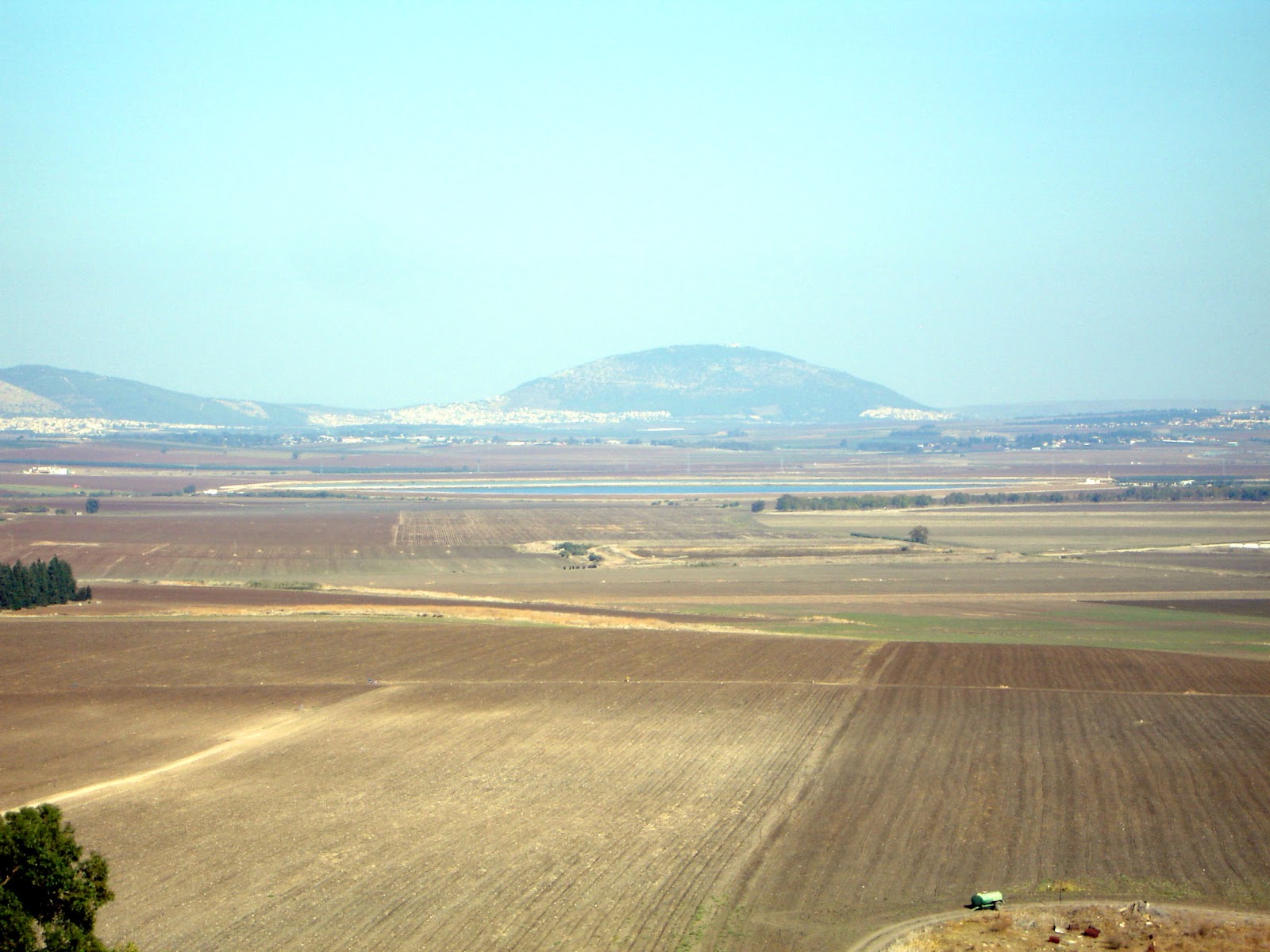
Mount Tabor from Megiddo
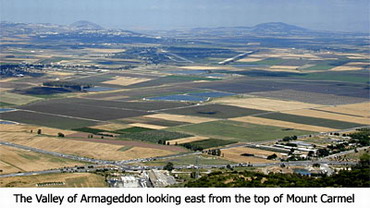
The Valley of Meggiddo Israel


  1. 7th Bowl - The Earth is Utterly Shaken.

Rev 16:17  Then the seventh angel poured his bowl into the air; and a loud voice came out of the sanctuary from the throne, saying, "Everything is now ready."
Saying,”Everything is now ready” (KJV It is done) - The series of judgments is about to be completed; the dominion of the beast is about to come to an end forever. The meaning here is, that that destruction was so certain, that it might be spoken of as now actually accomplished.

Rev 16:18  Flashes of lightning followed, and voices, and peals of thunder, and an earthquake more dreadful than there had ever been since there was a man upon the earth--so terrible was it, and so great!


And there were (kai egenonto). “And there came” (same verb ginomai). See Rev_8:5; Rev_11:19 for this list of terrible sounds and lightnings, and for the great earthquake (seismos megas) see Rev_6:12; Rev_11:13 (cf. Luk_21:11).
Such as was not (hoios ouk egeneto). Qualitative relative with ginomai again, “such as came not.”
Since there were men (aph' hou anthrōpoi egenonto). “Since which time (chronou understood) men came.”RWP

Rev 16:19  The great city was split into three parts; the cities of the nations fell; and great Babylon came into remembrance before God, for Him to make her drink from the wine-cup of His fierce anger.
Rev 16:20  Every island fled away, and there was not a mountain anywhere to be seen.

Rev 16:21  And heavy hail, that seemed to be a talent in weight, fell from the sky upon the people; and they spoke evil of God on account of the plague of the hail--because the plague of it was exceedingly severe.


Sunday, 30 November 2014

Eschatology: Event No 17 The Pouring out of the Seven Bowls of the Last Judgements.

Revelation  chapters 15-16

What do these Seven last Plagues Represent? and When do these events occur in History?
The Seven Angels with the Seven last Plagues
Rev 15:1  Then I saw another marvel (sign) in Heaven, great and wonderful--there were seven angels bringing seven plagues. These are the last plagues, because in them God's anger has found full expression. WNT
Rev 15:1 After this, I looked at the sky and saw something else that was strange and important. Seven angels were bringing the last seven terrible troubles. When these are ended, God will no longer be angry. CEV.

There are the Historicists who say that these were poured out on the Papacy in the past with the French Revolution and the Napoleonic Wars and will conclude in the future. Others say that these plagues were poured out on Jerusalem and the Jews. They seem to think that these verses refer to God’s judgments on Pagan Rome.

Most reliable interpreters see:
  1. These Bowls or Vials represent future, global Judgments that in their devastating effect are unparalleled in History.
  2. These occur at the very end of the Tribulation Period (of Seven years) culminating in the World War III or the Battle of Armageddon
  3. This war is the last Battle to be fought by mankind, and it will end with the Personal Appearing of Our Lord Jesus Christ as He comes to establish His Millennial Kingdom on Earth. Revelation; Four Views by Steve Gregg

Rev 15:1  Then I saw another marvel in Heaven, great and wonderful--there were seven angels bringing seven plagues. These are the last plagues, because in them God's anger has found full expression.
RWP “Seven angels (aggelous hepta). Accusative case in apposition with sēmeion after eidon. Cf. Rev_8:2.
Which are the last (tas eschatas). “Seven plagues the last.” As in Rev_21:9, “the final cycle of such visitations” (Swete).
Is finished (etelesthē). Proleptic prophetic first aorist passive indicative of teleō as in Rev_10:7. The number seven seems particularly appropriate here for finality and completeness.

Rev 15:2 And I saw what seemed to be a sea of glass mingled with fire, and those who had gained the victory over the Wild Beast and over his statue and the number of his name, standing by the sea of glass and having harps which belonged to God. Rev 15:3 And they were singing the song of Moses, God's servant, and the song of the Lamb.

Those who had victory over the Beast, His Statue and the Number of his name v.2 [These are the Tribulation saints]

Rev 15:3  And they were singing the song of Moses, God's servant, and the song of the Lamb.
Their words were, "Great and wonderful are Thy works, O Lord God, the Ruler of all. Righteous and true are Thy ways, O King of the nations.
Rev 15:4  Who shall not be afraid, O Lord, and glorify Thy name? For Thou alone art holy. All nations shall come and shall worship Thee, because the righteousness of all that Thou hast done has been made manifest." WNT


  1. They sing the song of Moses - That which Moses sang, Exo_15:1, when he and the Israelites, by the miraculous power of God, had got safely through the Red Sea, and saw their enemies all destroyed.
  2. And the song of the Lamb - The same song adapted to the state of the suffering, but now delivered Christians.
  3. Great and marvellous are thy works - God’s works are descriptive of His infinite power and wisdom.

Righteous and true are Thy ways, O King of the nations.WNT
(Just and true are Your ways, O King of saints.) MKJV


Every step God takes in grace or providence is according to justice, and He carefully accomplishes all His threatenings and all His promises; to this He is bound by His truth.A.Clark

God is always a God of Truth
"Because he who is blessed in the earth Will be blessed by the God of truth; And he who swears in the earth Will swear by the God of truth; Because the former troubles are forgotten, And because they are hidden from My sight! Isaiah 65:16

God cannot lie; His loving and holy perspective is always true. Jesus lived out that truth and perspective not only as an example for us to follow, but so that we might know the truth deep in our being. An essential key to our wholeness and freedom is receiving God’s truth and applying it to the beliefs that guide our lives.”
<http://rtfi.org/>
King of saints MKJV Differing renderings King of the Ages NIV King of the nations WNT
nations ethnos Grk. eth'-nos
Probably from G1486; a race (as of the same habit), that is, a tribe; specifically a foreign (non-Jewish) one (usually by implication pagan): - Gentile, heathen, nation, people.


Rev 15:4  Who shall not be afraid, O Lord, and glorify Thy name? For Thou alone art holy. All nations shall come and shall worship Thee, because the righteousness of all that Thou hast done has been made manifest." WNT
Who shall not be afraid, O Lord, and glorify Thy name? For Thou alone art holy.
Who shall not — Greek, “Who is there but must fear Thee?” Compare Moses’ song, Exo_15:14-16, on the fear which God’s judgments strike into the foe.

Exo 15:14  The people shall hear, being afraid. Sorrow shall take hold on the people of Philistia.
Exo 15:15  Then the princes of Edom were terrified. Trembling seized upon the mighty men of Moab. All the people of Canaan shall melt away.
Exo 15:16  Fear and dread shall fall upon them. By the greatness of Your arm they shall be still as a stone, until Your people pass over, O Jehovah; until the people whom You have purchased pass over.


all nations shall come — alluding to Psa_22:27-31; compare Isa_66:23; Jer_16:19. The conversion of all nations, therefore, shall be when Christ shall come, and not till then; and the first moving cause will be Christ’s manifested judgments preparing all hearts for receiving Christ’s mercy.
He shall effect by His presence what we have in vain tried to effect in His absence. The present preaching of the Gospel is gathering out the elect remnant; meanwhile “the mystery of iniquity” is at work, and will at last come to its crisis; then shall judgment descend on the apostates at the harvest-end of this age (Greek, Mat_13:39, Mat_13:40) when the tares shall be cleared out of the earth, which thenceforward becomes Messiah’s kingdom. The confederacy of ‘the apostates against Christ becomes, when overthrown with fearful judgments, the very means in God’s overruling providence of preparing the nations not joined in the Antichristian league to submit themselves to Him.

judgments — Greek, “righteousnesses.”


All nations shall come and shall worship Thee, because the righteousness of all that Thou hast done has been made manifest."
All nations shall Worship Him
worship :proskuneō   Strongs pros-koo-neh'-o
From G4314 and probably a derivative of G2965 (meaning to kiss, like a dog licking his master’s hand); to fawn or crouch to, that is, (literally or figuratively) prostrate oneself in homage (do reverence to, adore): - worship.

"Come let us worship and bow down"
Psalm 95:6

Rev 15:5  After this, when the doors of the temple [sanctuary] of the tent of witness in Heaven were opened, I looked;
See the notes as above on Act_7:44, where the same Greek phrase is used as here - rendered there “tabernacle of witness.” The word “temple” here - ναὸς  naos - does not refer to the whole of the building called the “temple,” but to the holy of holies. See the notes on Heb_9:3. This was regarded as the unique dwelling-place of God; and it was this sacred place, usually closed from all access, that now seemed to be opened, implying that the command to execute these purposes came directly from God himself.


Were opened - Were thrown open to the viewer John, so that he was permitted to look, as it were, upon the very dwelling-place of God. From his holy presence now came forth the angels to execute his purposes of judgment on that anti-Christian power which had so long corrupted religion and oppressed the world.


Rev 15:6  and there came out of the sanctuary the seven angels who were bringing the seven plagues. The angels were clad in pure, bright linen, and had girdles of gold across their breasts.


plagues:πληγή plēgē Thayer Definition:
1) a blow, stripe, a wound 2) a public calamity, heavy affliction, plague


Each one entrusted with a single “plague” to be executed upon the earth. The meaning here is, that they were designated or appointed to execute those plagues in judgments. The symbols of their office - the golden vials - were given to them afterward, Rev_15:7.


Rev 15:7  And one of the four living creatures gave the seven angels seven bowls of gold, full of the anger of God who lives until the Ages of the Ages.


four living creatures gave the seven angelsFrom the explanation given of the design of the representation of the “four beasts,” or living creatures, in the notes on Rev_4:6-7, it would seem that the meaning here is, that the great principles of that divine government would be illustrated in the events which are now to occur. In events that were so closely connected with the honor of God and the triumph of his cause on the earth, there was a propriety in the representation that these living creatures, symbolizing the great principles of divine administration, would be particularly interested.Barnes


seven bowls of gold, full of the anger of God who lives until the Ages of the Ages

Seven bowls of gold. The word used here - φιάλη  phialē - means properly, “a bowl or goblet, having more breadth than depth” (Robinson, Lexicon). Our word vial, though derived from this, means rather a thin long bottle of glass, used particularly by apothecaries and druggists. The word would be better rendered by “bowl” or “goblet,” and probably the representation here was of such bowls as were used in the temple service. See the notes on Rev_5:8. They are called in Rev_16:1, “vials of the wrath of God”; and here they are said to be “full of the wrath of God.” The allusion seems to be to a drinking cup or goblet filled with poison, and given to persons to drink - an allusion drawn from one of the methods of punishment in ancient times.

Golden saucers, but not full of incense as in Rev_5:8, but “full (gemousas for which see Rev_5:8) of the wrath of God who liveth for ever and ever” (tou thumou tou theou tou zōntos eis tous aiōnas tōn aiōnōn). Portents of dreadful events.